|
|
|
| The underrated recording Indigos (1957) showcases Ellington, Shorty Baker, and Johnny Hodges on a relaxed and bluesy “Prelude to a Kiss.” |
|
 |
|
- JW
|
|
| |
“Prelude to a Kiss” has undoubtedly become one of the top jazz standards, but its evolution to greatness was slow. On August 9, 1938, Duke Ellington and His Orchestra, featuring Johnny Hodges, recorded “Prelude to a Kiss” for the Brunswick label. A second version was recorded fifteen days later for the Vocalion label. This time it was by Johnny Hodges and His Orchestra with vocalist Mary McHugh.
|
| |
| |
|
| |
|
Johnny Hodges’ “orchestra” was composed of members of the Duke Ellington Orchestra including Ellington himself. Mary McHugh was with the Ellington band in 1938, recording a little over half a dozen songs. Along with “Prelude to a Kiss” she was the first to record “Lost in Meditation” with Ellington.
|
| |
| |
|
| |
|
The public liked the Mills/Gordon lyrics, and the Mary McHugh rendition went onto the charts in October rising to number thirteen. The instrumental charted a week later, rising to number eighteen.
|
| |
| |
|
| |
|
|
| |
| |
|
| |
|
Although “Prelude to a Kiss” is more popular with jazz performers today, Ellington’s 1938 million-selling “I Let a Song Go Out of My Heart” overshadowed both of its initial hit recordings. Rising to number one with both the Ellington and Benny Goodman orchestras, “I Let a Song Go Out of My Heart” stayed on the charts for nearly six months.
|
|
| |
|
| |
|
According to several Ellington experts, “Prelude to a Kiss” was adapted from a melody by alto saxophonist Otto “Toby” Hardwick. The resulting composition is often characterized as graceful, sensual, sultry, seductive, and tender--a perfect fit for Johnny Hodges’ alto saxophone abilities. In the book Jazz Styles: History and Analysis, author Mark C. Gridley comments that
[Hodges] is particularly known for a romantic approach to ballad playing that has pervaded American music ...His work on “Prelude to a Kiss” typifies that side of his talents.
|
| |
| |
|
| |
|
|
|
|
|
More information on this tune... |
|
- Jeremy Wilson
|
|
| This section suggests definitive or otherwise significant recordings that will help jazz students get acquainted with
“Prelude to a Kiss.” These recordings have been selected from the Jazz History and
CD Recommendations sections.
|
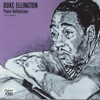
“Prelude to a Kiss” has received numerous wonderful treatments by Duke Ellington in various configurations, and one could conduct a thorough study of the song simply by examining these. The original instrumental version ( The Essential Duke Ellington) is vintage l930s Ellington ballad writing. Meanwhile, the first vocal recording of the tune ( This Is Jazz, Vol. 7) features a smaller ensemble drawn from the Ellington Orchestra and lets the lyrics and Mary McHugh’s interpretation of the melody take center stage. Fifteen years later, Ellington recorded a trio version of the tune ( Piano Reflections), offering yet another glimpse of his conception of “Prelude to a Kiss.”
Noah Baerman - Jazz Pianist and Educator
|
Written in an A1-A2-B-A2 form, the melody in
the first and third measures of each A section sidles
down the scale five halftones in a chromatic decline
while the fifth measure starts out with a note repeated
four times. The overall effect is a general flattening
of the melody, drawing the ear to Ellington’s rich
supporting harmonies.
The chromatic nature of “Prelude to a Kiss” produces
a plaintive sound, a sad serenade that Gordon and
Mills reflect in their lyrics. It’s the bridge,
however, that brings true emotional release, almost
to the point of seeming celebratory. Its corresponding
lyrics express Ellington’s dramatic change in mood,
relating the transformation of a pitiful love song
into a Schubert symphony. -JW
|
Musical analysis of
“Prelude to a Kiss”
|
| Original
Key |
C major,
modulating to E major during the “B”section |
| Form |
A1 – A2 –
B – A2 |
| Tonality |
Primarily
major |
| Movement |
The “A” section
consists of downward chromatic passages,
flattening out into repeated notes before
leaping up a ninth and down a sixth. It
then ascends stepwise again. Section “B”
dances across the range of the tune before
flattening out into repeated notes; it eventually
climbs chromatically, returning to the final
“A.” |
|
Comments
(assumed
background)
|
| Like the Basie/Hefti classic “Li’l Darlin’,” this starts on the secondary
dominant V7/V with a II7 – V7 – I sequence.
The I, which contains a seventh at this
point, is itself a secondary dominant of
IV to which the progression continues. This
same “circle of fifths” sequence is repeated
a minor third lower, ending on a ii7 – V7
– I to which the composers add embellishing
chords to delay the final resolution to
I. At the end of the second “A,” the tonic
is followed by a VII7 chord which easily
modulates into the new key. In section “B,”
a I – vi – ii7 – V7 progression is used
along with its functional variant, iii –
biii˚7 – ii7 – bII7.
The modulation back to section “A” is
a masterpiece of subtlety: it begins with
what appears to be a I – IV cadence on paper
(E – A in the original), except that the
IV contains the minor seventh and a flatted
ninth, clearly sounding as if it were going
“somewhere else.” (The A7(b9) here is really
a V7 of D, with the flatted ninth adding
a strong hint of vii˚7 of D). The resolution
turns out to be a Dm11 (the melody note
is the 11th in this case). The harmonic
progression rises two half-steps to Em11,
then back down to Eb7, and eventually to
the initial D13 in the first measure of
“A,” while the melody continues upward,
landing on the B natural that is the first
melody note as well as the13th of the D
chord. |
|
K. J. McElrath - Musicologist for JazzStandards.com |
|
Texas tenor saxophonist John Hardee, a late, swing-era, rising star, unfortunately
came along as jazz was moving into bebop. His style had a nice, Don Byas-type approach
but was just too similar to other players, and he left New York, returning to Dallas.
His 1948 recording of “Prelude...” shows that he had fine ability with a ballad,
and the record also spotlights bop pianist Al Haig.
Composer Duke Ellington, in an unusual album as a featured solo player, recorded
an excellent trio version of his tune in 1953.
In a 1954 session with strings, “used to be Duke Ellington tenor player” Ben
Webster pays homage to his former section mate, alto saxophonist
Johnny Hodges, for whom the tune was a feature with Ellington.
Chris Tyle - Jazz Musician and Historian
|
Additional information for "Prelude to a Kiss" may be found in:
|
|
|
 James Lincoln Collier
Duke Ellington
Oxford University Press, USA
Hardcover: 352 pages
(1 paragraph including the following types of information: music analysis.)
|
|
|
|
|
 Robert Gottlieb, Robert Kimball
Reading Lyrics
Pantheon
Hardcover: 736 pages
(Includes the following types of information: song lyrics.)
|
|
|
|
|
“Prelude to a Kiss” was included in these films:
- Fabulous Baker Boys (1989,
The Duke Ellington Orchestra)
- Glengarry Glen Ross (1992,
Bill Holman Big Band)
- Prelude to a Kiss (1992, Deborah
Harry)
- White Man’s Burden (1995,
The Michael Lang Trio)
And on stage:
- Sophisticated Ladies (1981,
Phyllis Hyman) Broadway musical
- Play On! (1997, Carl Anderson)
Broadway musical
And on television:
- Play On! (2000, Raun Ruffin)
PBS Great Performances
|
|
|
|
Comment Policy
- Your comments are welcome, including why you like
this tune, any musical challenges it presents, or additional background information.
- Jazz musicians, fans, and students of all ages use this website as an educational resource.
As such, off-topic, off-color, unduly negative, and patently promotional comments will be removed.
- Once submitted, all comments become property of JazzStandards.com.
By posting, you give JazzStandards.com permission to republish or otherwise distribute your comments in any format or other medium.
JazzStandards.com reserves the right to edit or remove any comments at its sole discretion.
|
|
| Click on any CD for more details at Amazon.com |
 Duke Ellington
The Essential Duke Ellington
Sony
Original recording 1938
|
|
This is the original recording of the tune and it is an absolute gem. Different members of Ellington’s orchestra take turns playing parts of the melody, and we are therefore treated to a great demonstration of Ellington’s ability to balance lush, cohesive orchestration with the distinct voices of his musicians.
|
 Duke Ellington
This Is Jazz, Vol. 7
1996 Sony 64617
Original recording 1938
|
|
Here we find the tune’s second recorded version. This is the original vocal recording, with the singing of Mary McHugh and released under the leadership of saxophonist Johnny Hodges. The simultaneous trickiness and lyricism of the melody can be heard here, and the light tone of McHugh’s voice would be echoed in subsequent instrumental renditions by Hodges himself
|
 Pee Wee Russell
Ask Me Now (Dig)
Umvd Labels
|
|
Primarily known as a Dixieland player, Russell showed the jazz world on this recording that his always daring style was well-suited to playing in a more modern context. His reading of “Prelude to a Kiss” alongside valve trombonist Marshall Brown is stunning in its tenderness and melodic invention.
|
|
 Nancy Wilson
But Beautiful
Blue Note Records
Original recording 1969
|
|
Wilson sings with phenomenal warmth on this performance alongside such all-stars as guitarist Gene Bertoncini and pianist Hank Jones.
|
 Jim Hall With the Ron Carter Duo
Alone Together
Ojc
Original Recording 1972
|
|
The lyricism of Carter and Hall and the almost telepathic quality of their interplay with one another prove to be in perfect sync with the mood of this song.
|
 Sarah Vaughan
Swingin' Easy
1992 Polygram 14072
Original recording 1954
|
|
Backed only by her trio, Vaughan sings this tune with striking intimacy, though with complete mastery of the tune’s melodic twists and turns.
|
 World Saxophone Quartet
Plays Duke Ellington
Nonesuch
Original recording 1986
|
|
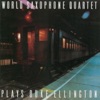
The World Saxophone Quartet rendition of “Prelude to a Kiss” is energetic, spunky and even a little reckless at times, while maintaining the tune’s melodic sense and rich harmonies.
|
 Brad Mehldau
Introducing Brad Mehldau
1995 Warner Bros. 45997
|
|
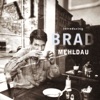
Pianist Mehldau’s 10-minute arrangement of the piece is one of the most thoughtful and mesmerizing renditions of any song, let alone this one.
|
 Joe Lovano
Rush Hour
1995, Blue Note 29269
|
|
Saxophonist Lovano is backed by an orchestra conducted by Gunther Schuller on this full-bodied track. The result is lush. The jazz group is given space to improvise in the foreground while enjoying Schuller’s support rather than direction.
|
 Claudia Acuna
Wind From the South
2000, Verve 314543521
|
|
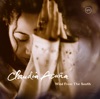
Chilean singer Claudia Acuna provides an upbeat rendition of the song. The tempo and her Latin vocals give the Ellington ballad a touch of the exotic.
|
 Bobby Timmons
This Here Is Bobby Timmons
1991, Orig. Jazz Classics #104
Original recording, 1960
|
|
Pianists seem to love “Prelude to a Kiss.” Timmons takes it sweetly as a solo before bassist Sam Jones and finally drummer Jimmy Cobb join him. The other eight cuts are divided between standards and Timmons’ own witty compositions.
|
|
|
|